
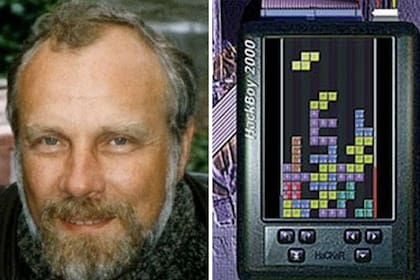
Vladimir Pokhilko was a clinical psychologist who got involved with Tetris through his friend Alexey Pajitnov and was one of the first people to realize how addictive it was.
He appears to have been largely supportive and enthusiastic about the development of the game, believing that its simple mechanics were surprisingly effective in provoking addiction. Some sources even suggest that he was responsible for significant parts of the development, although in practice, it seems unlikely he could have been directly responsible for most of the coding in Tetris. It appears that he was significantly less involved than his friend Alexey Pajitnov in the actual creation of Tetris.
Vladimir later worked with Alexey on a Moscow-based software company called AnimaTek that specialized in animation, and the two eventually moved to the US after the dissolution of the Soviet Union. Pokhilko later settled in the San Fransisco bay area, continuing his work in the intersection of psychology and software. He appears to have had no significant problems aside from his professional challenges following the end of his work with Tetris.
Later Years and Death
In 1998, he was found dead in his Palo Alto home, along with his wife and son, in what appeared to be a murder-suicide. The details of his death later became the subject of significant amounts of conjecture and controversy, being one of the final cases that the Palo Alto police department could fully solve before its dissolution. This tragedy was later linked by some to his professional disagreements with other figures in the Tetris community, although no definitive proof of any connection to his death was ever found.
Vladimir Pokhilko was one of the few people to have worked on Tetris who had been directly exposed to psychology, and his early and enthusiastic endorsement of the game as an addictive stimulus appears to have made him an unexpectedly qualified advisor for the project.
He appears to have retained a unique perspective on Tetris as an addictive loop throughout his time working on it, one that few of his colleagues could share. His untimely death cut short his professional contributions to the video game industry and removed one of the few people who had been actively exposed to the addictive nature of Tetris from public life.