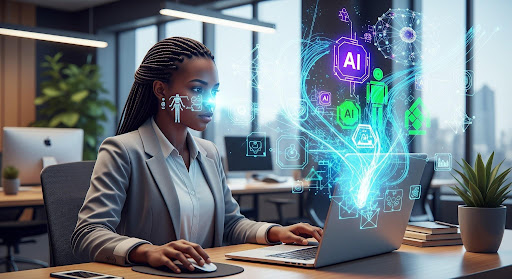
Artificial intelligence is changing the way people work, and the shift is happening much faster than many expected.
From writing emails and analysing information to handling customer enquiries, preparing presentations and organising daily tasks, AI tools are already becoming part of normal workplace routines.
But while the rise of AI has sparked fears that millions of jobs could disappear, the bigger story may be slightly different. Rather than replacing every human worker, artificial intelligence is increasingly changing what employers expect from workers.
For many professionals, the real risk may not be AI itself, but falling behind colleagues who have learned how to use it effectively.
AI Skills Are Becoming an Advantage at Work
Employers across different industries are becoming more interested in people who can combine traditional workplace abilities with modern digital tools.
Marketing professionals, customer service workers, human resources staff, accountants, administrators and sales teams are among those already finding practical ways to use AI in their everyday responsibilities.
A worker who can use AI to quickly research a topic, organise information, draft a presentation or handle repetitive tasks may have more time to concentrate on work that requires human judgement.
This is gradually changing the meaning of being productive at work.
Instead of spending hours on tasks that can be completed more efficiently with technology, employees can use AI as an assistant while they remain responsible for checking information, making decisions and delivering the final result.
You Do Not Have to Become a Programmer
One common misunderstanding about the AI revolution is that workers need to become software developers before they can benefit from it.
That is not necessarily the case.
For an ordinary office worker, business owner or professional, basic AI skills can already make a noticeable difference.
Knowing how to use AI for research, brainstorming, writing, summarising documents, preparing presentations, organising tasks and generating ideas can help workers save time and improve their output.
The important thing is not simply knowing how to open an AI tool. Workers also need to understand how to ask useful questions, identify mistakes and verify information before using AI-generated content in professional situations.
In other words, AI can assist with the work, but the human still needs to be in charge.
Human Skills Could Become Even More Important
Interestingly, the growth of artificial intelligence could make some human abilities more valuable rather than less important.
Communication, creativity, leadership, emotional intelligence, adaptability and critical thinking are difficult to reduce to a simple automated process.
A machine may help prepare a response, analyse a large amount of information or generate several ideas, but knowing how to communicate with a frustrated customer, lead a team, understand another person’s concerns or make a difficult business decision still requires human judgement.
This is particularly important in workplaces where trust and relationships matter.
The Workers Who Adapt May Have the Edge
The workplace is unlikely to remain exactly the same as AI becomes more capable.
Some tasks will become automated, while others may be redesigned around technology. New roles are also likely to emerge as businesses discover different ways of using AI.
For workers, this means learning cannot stop after getting a degree, certificate or first job.
Someone who started working years ago may now need to learn tools that did not exist when they entered the workforce. Likewise, younger professionals entering the job market may find that having a qualification alone is no longer enough to stand out.
The advantage could increasingly go to people who are willing to learn, experiment and adjust as technology changes.
AI May Not Take Your Job, But Someone Using AI Could Compete With You
The growing conversation around artificial intelligence is therefore becoming less about whether humans will suddenly lose all their jobs and more about how workers will adapt to a changing workplace.
AI is not perfect, and it still makes mistakes. Human oversight remains important, particularly when decisions involve customers, money, sensitive information or business strategy.
However, ignoring the technology completely could become a disadvantage.
For Nigerian workers navigating an already competitive job market, learning how to use AI alongside existing professional skills could be one practical way to remain relevant as employers continue to embrace digital tools.
The future of work may not belong entirely to humans or machines. It could belong to people who know how to make both work together.